




Nozzle Maintenance Schedule: Extending Service Life
A properly executed spray nozzle maintenance schedule can extend nozzle service life by 40-60% while reducing operational costs by up to 30%. The key is systematic daily inspections combined with weekly cleaning, monthly flow rate testing, and replacement when flow exceeds manufacturer specifications by 10%. This guide provides the exact maintenance intervals, inspection criteria, and replacement thresholds used in high-performance industrial facilities worldwide.
- 1. Why Nozzle Maintenance Matters: The Real Cost of Neglect
- 2. Daily Inspection Protocol: What to Check Every Shift
- 3. Weekly Maintenance Tasks: Cleaning and Prevention
- 4. Monthly Performance Testing: Flow Rate Verification
- 5. Quarterly Deep Maintenance: Comprehensive System Review
- 6. Wear Indicators: When to Replace vs Clean
- 7. Material-Specific Maintenance Schedules
- 7.1. Environment-Specific Adjustments
- 8. Documentation and Record Keeping
- 9. FAQ
- 10. Conclusion
Why Nozzle Maintenance Matters: The Real Cost of Neglect
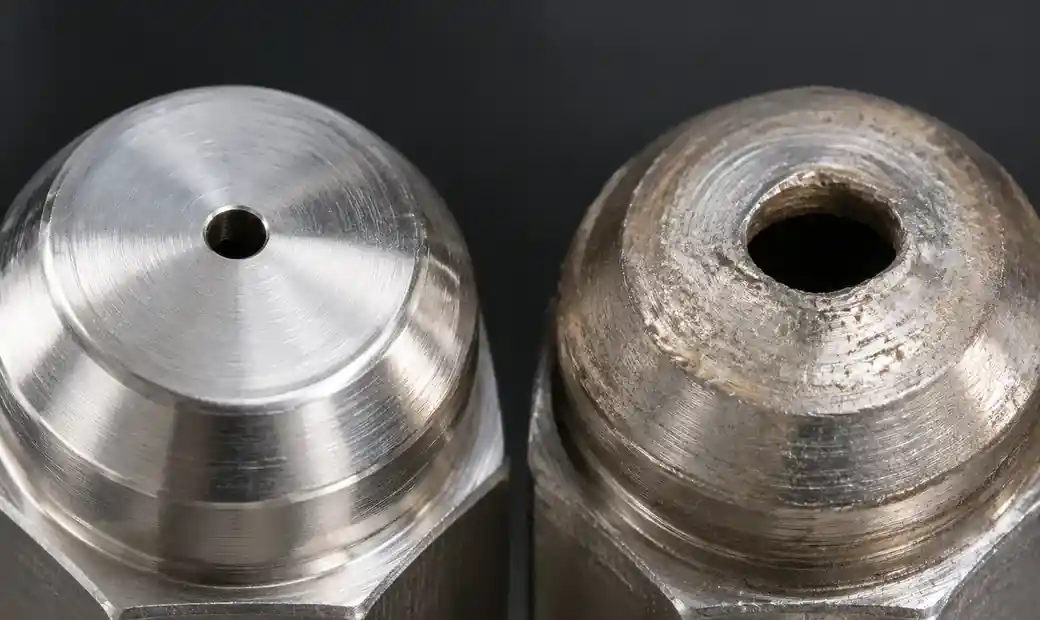 Side-by-side comparison showing new versus worn industrial spray nozzle orifices under magnification
At YuechenPrecision Technology, analysis of 8,000+ installations shows facilities with structured maintenance achieve 3-5 year nozzle lifespans versus 6-18 months for reactive approaches. A worn nozzle increases flow rates by 10-30%, wasting thousands annually. For a 100 GPM system, 10% excess flow wastes $1,584 yearly in water alone.
Erosion from abrasive particles enlarges orifices—brass nozzles degrade after 500-800 hours in abrasive service. Corrosion from acidic/alkaline liquids causes metal flaking. Clogging from particulate buildup distorts spray patterns.
Daily Inspection Protocol: What to Check Every Shift
Daily 5-10 minute inspections prevent 80% of unplanned downtime. Check spray patterns against contrasting backgrounds for uniform distribution. Warning signs:
- Streaking/gaps indicate partial blockage
- Heavy center flow signals internal wear
- Asymmetric patterns suggest orifice deformation
- Pulsing reveals air entrainment or pressure fluctuations
 Industrial facility technician inspecting spray nozzle patterns during daily maintenance check
Compare pressure gauges to baseline values. Pressure drops of 10-15% indicate nozzle enlargement; increases suggest clogging. Check for leaks at connections—minor drips waste 3-5 gallons daily. Inspect bodies for corrosion, mineral deposits, cracks, or loose mounting. Tank cleaning nozzles accumulate deposits faster.
Weekly Maintenance Tasks: Cleaning and Prevention
Weekly maintenance extends nozzle life 2-3x. Never use metal tools—wire brushes enlarge orifices by 0.002-0.005", increasing flow 8-15%. Proper procedure:
- Remove nozzles with proper wrenches
- Rinse under 40 PSI water
- Soak 15-30 minutes in appropriate cleaner
- Use soft nylon brushes or wooden probes
- Flush with compressed air (60 PSI max)
- Inspect under 10x magnification
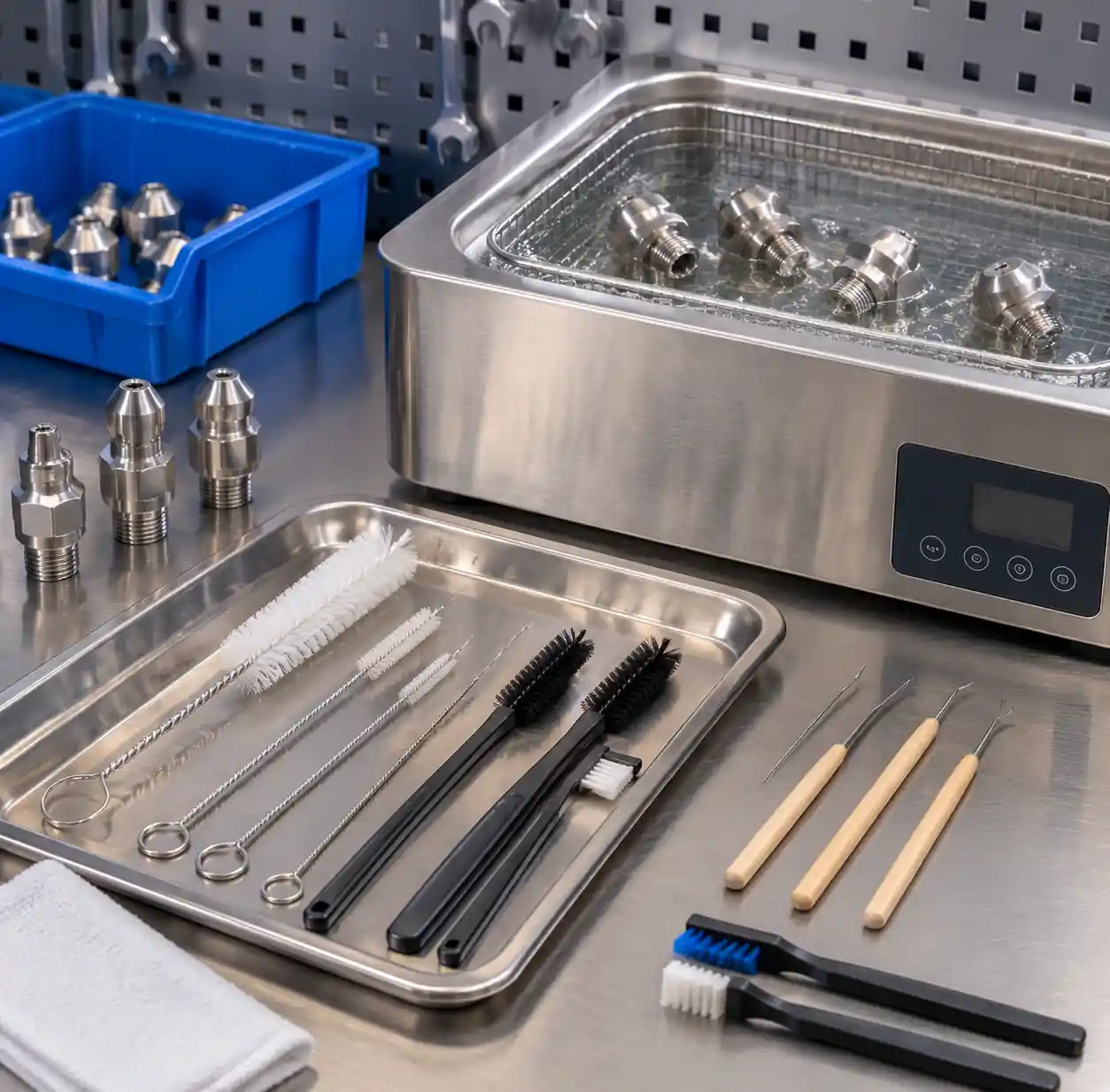 Proper nozzle cleaning tools including soft brushes, wooden probes, and ultrasonic cleaning bath
Ultrasonic cleaning removes 95% of deposits without contact—standard for air atomizing nozzles.
| Application Type | Cleaner | Soak Time |
|---|---|---|
| Hard water scale | 5% citric acid | 20-30 min |
| Oil/grease | Alkaline degreaser | 15-20 min |
| Protein deposits | Enzymatic cleaner | 30-45 min |
| General purpose | Mild dish soap | 10-15 min |
Inspect inline filters weekly: 100 mesh for full cone and hollow cone nozzles, 200 mesh for fine misting, 325 mesh for flat fan nozzles. Replace when differential pressure exceeds limits.
Monthly Performance Testing: Flow Rate Verification
Flow rate testing identifies wear before visible pattern changes. Test procedure:
- Set system to manufacturer's test pressure (typically 40 PSI)
- Collect full spray for 60 seconds
- Calculate: (ounces × 7.5) ÷ seconds = GPM
- Compare to specifications
- Document results
 Technician measuring spray nozzle flow rate using graduated container and pressure gauge
Replace at 10% flow increase—industry standard where waste costs exceed replacement. For 2.5 GPM rated nozzle: acceptable 2.25-2.75 GPM, marginal 2.76-3.0 GPM, replace >3.0 GPM. Flow below 90% indicates clogging—clean and retest. Establish baselines within first week of new installations.
Quarterly Deep Maintenance: Comprehensive System Review
 Comprehensive spray system inspection showing manifold, pressure gauges, and multiple nozzle installation
Every 90 days, perform complete system evaluation: test pump delivery against design specs, check pipes for internal corrosion/scale, verify pressure regulator accuracy, inspect quick coupling seals.
Use water-sensitive paper to document coverage patterns. Compare to commissioning photos—gradual drift indicates multi-nozzle wear. For dry fog humidification, measure droplet size; worn nozzles produce 15-30% larger droplets.
Budget-constrained facilities can rotate nozzles: new to critical positions (product contact, safety), 85-95% flow to secondary (pre-rinse), 95-105% flow to tertiary (dust suppression), retire >110% flow.
Wear Indicators: When to Replace vs Clean
Distinguishing wear from clogging determines whether cleaning solves the problem. This chart provides decision criteria based on 8,000+ field evaluations.
| Symptom | Probable Cause | Action | Urgency |
|---|---|---|---|
| Flow increased 10-15% | Erosion wear | Replace | Within 1 week |
| Flow increased 15-30% | Advanced erosion | Replace immediately | Same shift |
| Flow decreased 10-20% | Partial clog | Clean and retest | Within 2 days |
| Pattern shows gaps/streaks | Clog or damage | Clean first, replace if persists | Within 1 day |
| Heavy center flow | Internal passage wear | Replace | Within 1 week |
| Asymmetric pattern | Orifice deformation | Replace | Within 3 days |
| Visible orifice damage | Corrosion or impact | Replace immediately | Same shift |
| Pressure drop 15%+ at manifold | Multiple nozzle wear | Test/replace affected units | Within 1 week |
Critical safety note: Replace immediately, not repair, nozzles in firefighting systems or chemical process safety showers. These applications cannot tolerate any performance degradation.
Material-Specific Maintenance Schedules
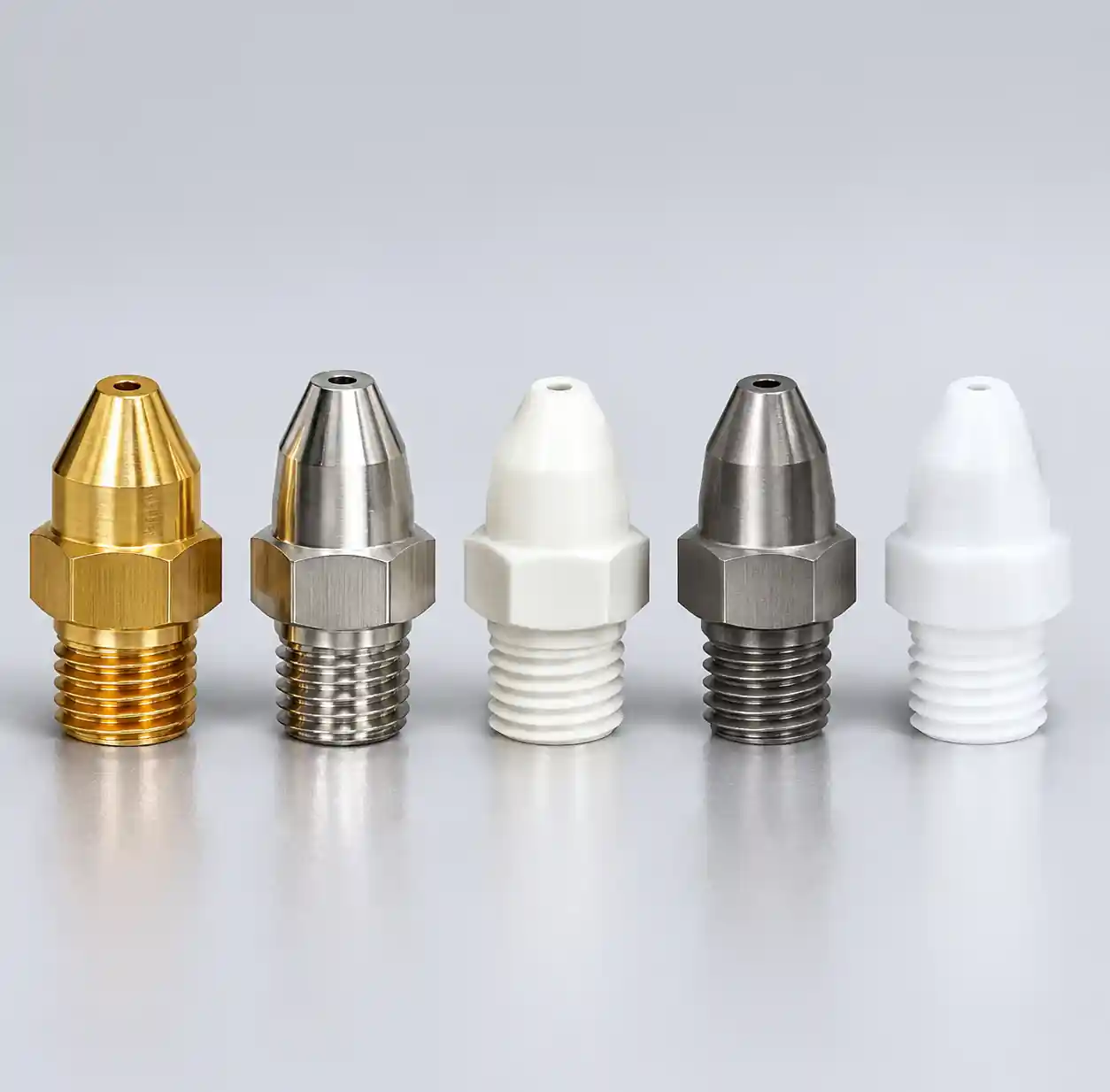 Various spray nozzle materials including brass, stainless steel, ceramic, and plastic displayed for comparison
Nozzle material determines maintenance frequency and expected service life. Match your schedule to the installed materials.
| Nozzle Material | Typical Service Life | Inspection Frequency | Best Applications | Maintenance Notes |
|---|---|---|---|---|
| Brass | 1-2 years | Weekly | General water, mild chemicals | Prone to erosion; replace at 10% wear |
| Stainless Steel 303 | 2-3 years | Bi-weekly | Non-corrosive applications | Better wear resistance than brass |
| Stainless Steel 316 | 3-5 years | Bi-weekly | Corrosive chemicals, marine | Excellent corrosion resistance |
| Hardened Stainless | 4-7 years | Monthly | Abrasive slurries, mining | Premium cost justified in severe service |
| Ceramic | 5-10 years | Monthly | Extreme abrasion, high temp | Brittle—avoid impact; premium price |
| PTFE/Plastic | 6 months - 2 years | Weekly | Highly corrosive acids/bases | UV degradation; chemical compatibility critical |
| Tungsten Carbide | 8-15 years | Quarterly | Severe abrasion, metal cutting | Highest wear resistance; very expensive |
For plastic nozzles, inspect weekly for UV degradation (chalking, cracks) and stress cracking from solvents. Polypropylene and PVDF offer better chemical resistance than standard PVC.
Environment-Specific Adjustments
High-temperature service (>180°F): Inspect weekly for thermal stress cracking. Verify nozzle material rating exceeds maximum operating temperature by 50°F minimum.
Outdoor installations: UV exposure degrades plastics 3-5x faster. Use UV-stabilized materials or stainless steel. Clean mineral deposits monthly in hard water regions.
Abrasive environments: Switch from weekly to daily inspections. Pre-filtration to 100 mesh or finer extends life 4-8x. Consider hardened materials when replacing brass nozzles more than annually.
Corrosive chemicals: Verify material compatibility using manufacturer chemical resistance charts. Test pH monthly—liquid chemistry drift causes unexpected corrosion. Clamp spray nozzles with replaceable inserts allow material upgrades without replacing the body.
Documentation and Record Keeping
Systematic records enable predictive optimization. Clients with digital logs achieve 30-40% longer nozzle life through early intervention.
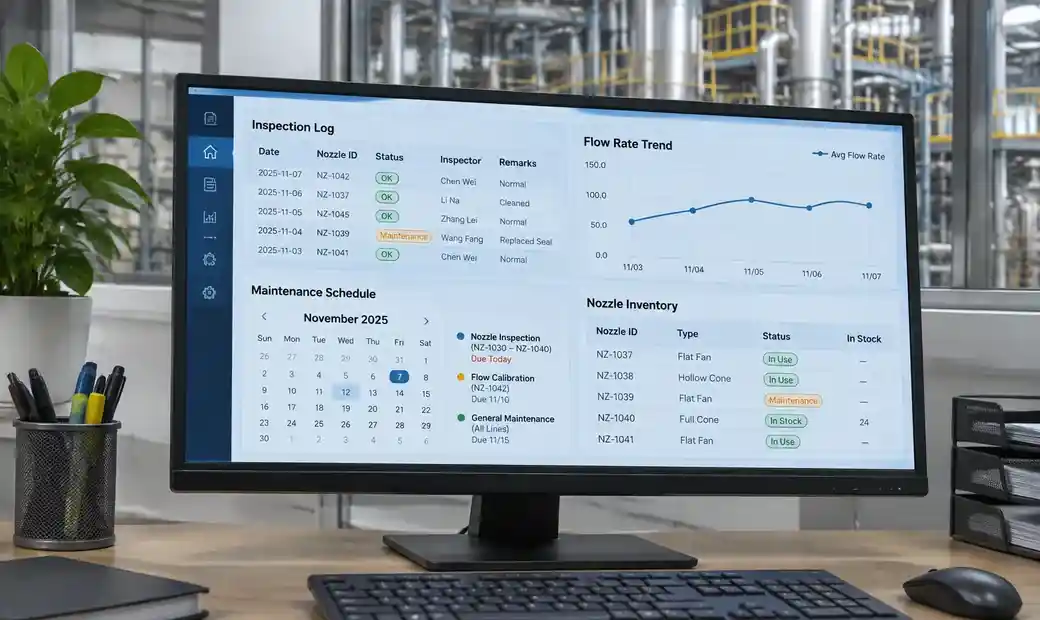 Digital maintenance tracking system showing nozzle inspection logs and flow rate trend data
Essential records: nozzle inventory (location, part number, install date, material, specs), inspection logs (daily checks, weekly cleaning, monthly flow tests), failure analysis (mode, operating hours, root cause). With 6-12 months flow data, plot wear curves to predict replacement timing. Track total cost: direct (purchase, labor), indirect (wasted materials, energy), and downtime costs.
FAQ
How often should I inspect spray nozzles?
Daily visual inspections plus weekly cleaning and monthly flow testing provide optimal balance. Adjust for conditions—abrasive or corrosive applications need more frequent checks.
Can I clean nozzles with compressed air without removing them?
Compressed air (60 PSI max) works for loose debris but cannot remove hard deposits or verify internal condition. Remove and clean weekly for best results.
What's the replacement threshold for worn nozzles?
Replace when flow increases 10% above specification. This standard applies where waste costs exceed replacement costs. Precision applications may use 5%.
How can I extend nozzle life in abrasive applications?
Install 100-200 mesh filtration, upgrade to hardened stainless or ceramic, reduce pressure if possible, and implement daily inspections. Combined, these extend life 3-6x.
Should I stock spare nozzles?
Stock 10% spares for critical nozzles, 20% for high-wear applications. Specialty nozzle lead times reach 4-8 weeks. Spares prevent extended downtime.
Can I repair damaged nozzles?
No. Minor orifice damage permanently alters spray characteristics. Replace immediately. Exception: nozzles with replaceable inserts—replace insert, not body.
Conclusion
Structured spray nozzle maintenance delivers measurable returns: 40-60% longer service life, 20-30% reduced chemical consumption, and eliminated emergency downtime. Consistency is key—daily inspections catch problems early, weekly cleaning prevents deposits, monthly testing triggers timely replacement before waste exceeds costs.
Start with daily visual inspections, add weekly cleaning for high-wear positions, implement monthly flow testing within 90 days. These three steps capture 80% of potential benefits.
Material selection matters as much as maintenance frequency. Brass in abrasive service rarely justifies low initial cost when lifecycle analysis includes replacement labor and waste. Upgrading to stainless or hardened materials typically pays back within 12-18 months.
Document everything. Maintenance logs become predictive tools when analyzed for trends. Your future replacement schedule emerges from past failure patterns—but only if recorded.
For application-specific guidance, contact YuechenPrecision Technology's technical support for custom maintenance protocols based on your operating conditions and production requirements.