
Water Mist Nozzles for Fire Suppression: Technology and Applications

Jul 29, 2026
瀏覽次數: 17

Water mist fire suppression is one of the most significant advances in fire protection engineering of the past three decades. Unlike conventional sprinklers that douse a space with large water volumes, water mist nozzles atomize water into microscopic droplets—typically below 1,000 µm—that extract heat faster, displace oxygen more efficiently, and cause far less collateral damage.

For engineers, safety managers, and facility operators, understanding the nozzle's role is the difference between a system that holds up under real fire conditions and one that merely looks compliant on paper.

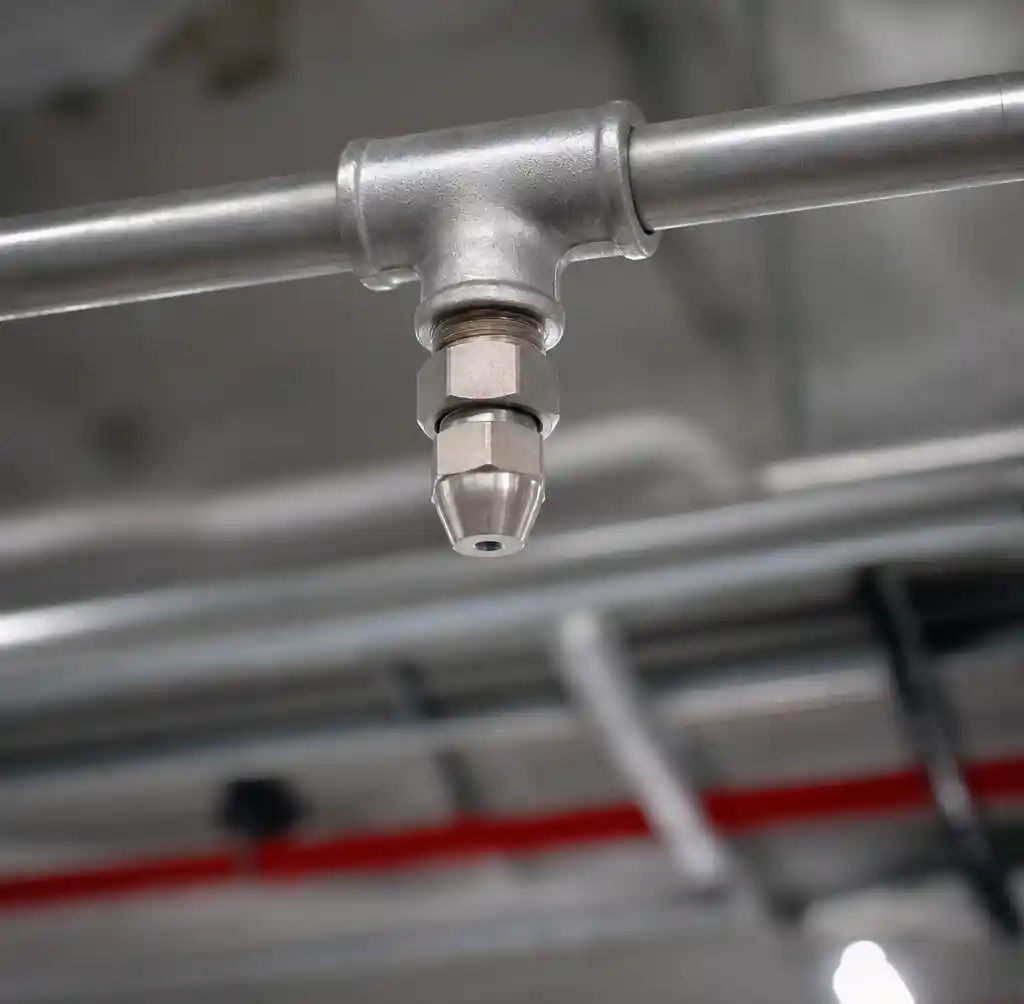
1-water-mist-nozzle-firefighting-installation Water mist fire suppression nozzle installed on a ceiling pipe in an industrial facility

Table of Contents

  1. How Water Mist Suppresses Fire
  2. Pressure Classifications and What They Mean
  3. Nozzle Design: Types and Spray Patterns
  4. Key Application Environments
  5. Water Mist vs. Traditional Sprinklers
  6. Nozzle Selection: Five Variables That Matter
  7. FAQ
  8. Conclusion

1. How Water Mist Suppresses Fire

Water mist works through three simultaneous mechanisms—precisely why it outperforms single-mode suppressants across different fire classes.

Heat extraction: Fine droplets have an extremely high surface-area-to-volume ratio, accelerating evaporation directly in the fire plume. Water's latent heat of vaporization is 2,260 kJ/kg—that energy comes entirely from the flame.

Oxygen displacement: When water vaporizes to steam, it expands approximately 1,700 times in volume. In enclosed or semi-enclosed spaces, this displaces available oxygen and inerts the combustion zone—without depositing chemical residue.

Fuel surface cooling: Fine droplets penetrate fire convective currents and settle on surrounding fuel surfaces, raising ignition thresholds and limiting fire spread beyond the original seat.

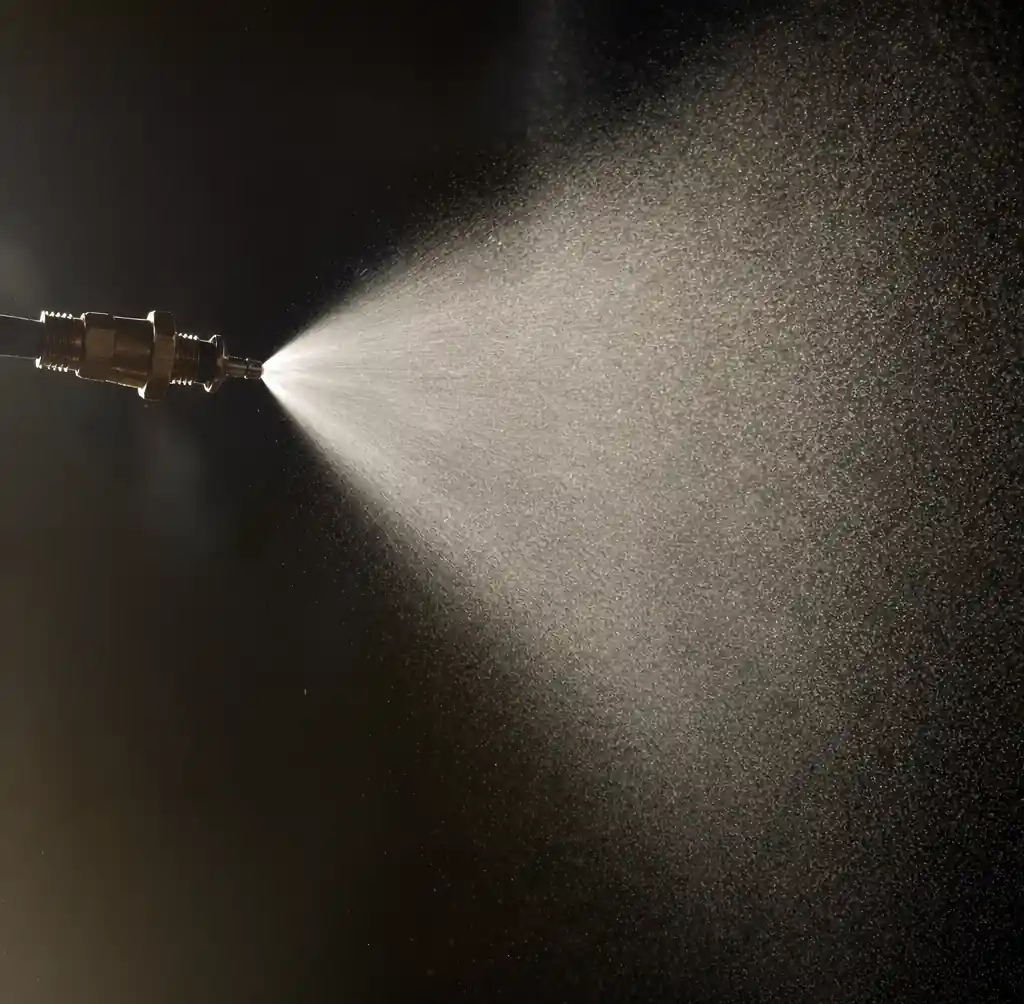
2-water-mist-spray-fire-suppression-action Fine water mist spray discharging from a fire suppression nozzle showing fog-like droplet pattern

Research published in Fire (MDPI, 2022) confirmed that swirl-type water mist nozzles reduce protected-zone temperatures by 20–45°C compared to standard spray conditions, while significantly cutting smoke spread. That thermal gap directly affects structural exposure time and evacuation windows—outcomes that matter in any occupied facility.

2. Pressure Classifications and What They Mean

NFPA 750 defines three operating pressure tiers for water mist systems. The pressure class governs nozzle orifice design, pump specification, droplet size, and the fire scenarios a system can reliably address.

Pressure Class Operating Pressure Typical Dv50 Droplet Size Primary Applications
Low Pressure ≤ 12.1 bar (175 psi) 400–700 µm Residential, local-application systems
Intermediate Pressure 12.1–34.5 bar (175–500 psi) 150–350 µm Commercial, hotels, healthcare
High Pressure > 34.5 bar (> 500 psi) 30–150 µm Marine, turbines, data centers

The classification threshold under NFPA 750 is the Dv99—the droplet diameter below which 99% of spray volume falls. Any system delivering Dv99 < 1,000 µm qualifies as a water mist system. High-pressure installations operating above 100 bar routinely achieve Dv99 values below 200 µm.

A practical note from the field: specifying a pressure class without verifying nozzle-system listing compatibility is one of the most common sources of commissioning failures. The nozzle's rated pressure range must match actual system operating pressure during activation—not just nominal design pressure.

3. Nozzle Design: Types and Spray Patterns

The nozzle converts hydraulic pressure into the droplet spectrum that does the suppression work. Two fundamental atomization approaches dominate fixed suppression installations.

Single-fluid (hydraulic) nozzles use water pressure alone to drive atomization through precision orifice geometries. Mechanically simpler and requiring no secondary gas supply, they are the standard choice for high-pressure fixed systems.

Twin-fluid (air-atomizing) nozzles introduce compressed air at the nozzle tip to enhance atomization. They produce finer droplets at lower water pressures—useful where extreme droplet fineness is needed without high hydraulic infrastructure.

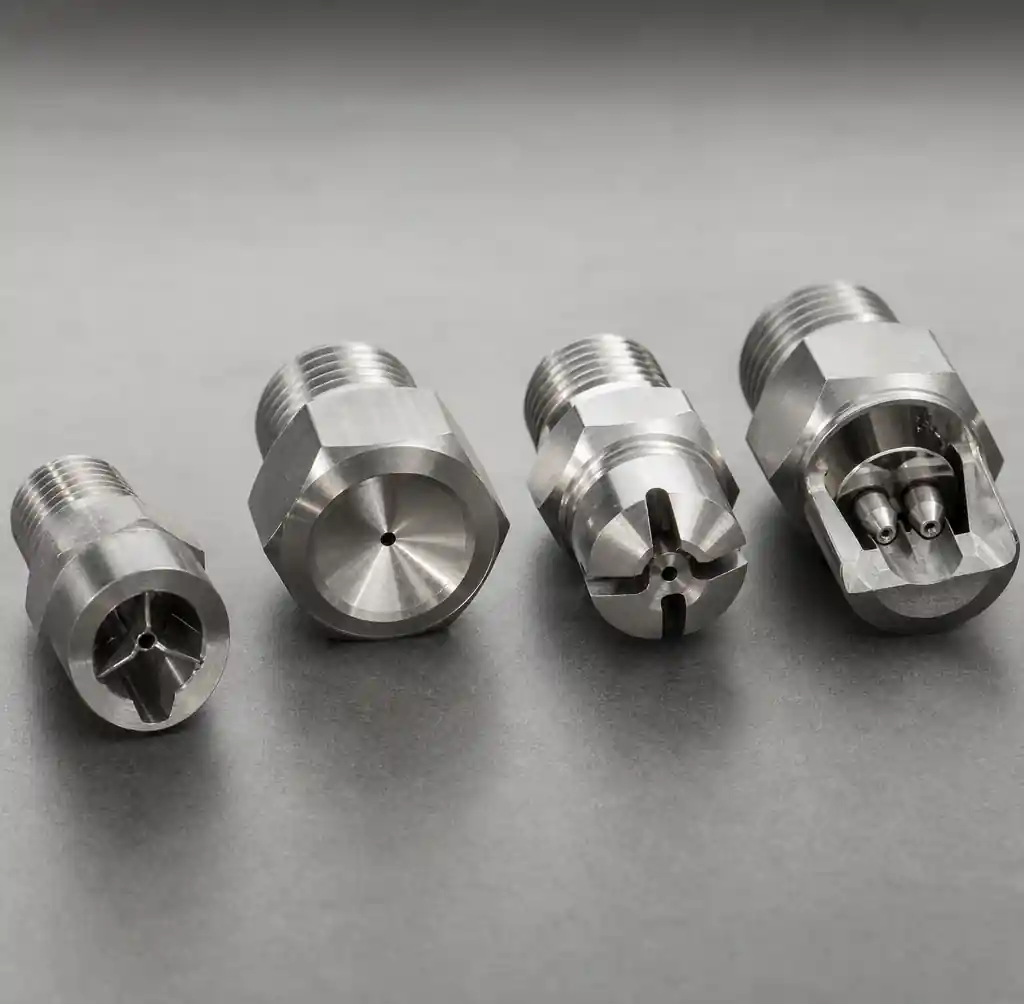
3-water-mist-nozzle-types-spray-patterns Several water mist nozzle heads of different spray pattern designs arranged for comparison

Spray pattern geometry shapes coverage and penetration. Hollow cone nozzles concentrate water at the outer spray edge—maximizing coverage area per nozzle and optimizing oxygen displacement in open machinery spaces. Full cone nozzles deliver uniform distribution across the full cross-section, preferred when a defined hazard zone requires complete, even wetting.

For fire-rated suppression installations, YuechenPrecision Technology's Water Mist Nozzles for Firefighting are engineered to IMO and NFPA 750 design requirements with SS316 stainless steel construction and tested K-factor performance across rated pressure ranges.

4. Key Application Environments

Water mist systems have expanded far beyond their origins in marine engineering. Five sectors now drive the majority of new installations globally.

4-water-mist-system-data-center-server-room Water mist fire suppression piping and nozzles installed above server racks in a data center

Marine and offshore: IMO MSC/Circ.1533 and the Fire Safety Systems (FSS) Code govern type-approval requirements for water mist in engine rooms, accommodation quarters, and machinery spaces on passenger vessels. In occupied spaces, water mist is often the only viable alternative to CO₂ total flooding, which creates life-safety risks during activation sequences.

Data centers and server rooms: Post-suppression equipment damage from water is the second leading cause of extended downtime in data center fire events. Water mist reduces discharge volume by 70–90% compared to conventional sprinklers. Fine misting fog nozzles are specifically suited here, where electrical safety and minimal residue are essential.

Industrial turbine enclosures: Gas turbine enclosures present high-consequence fire hazards—flammable fluids under pressure, high ignition energy, and occupied nearby structures. High-pressure water mist is the specification standard under both NFPA 750 and FM 5-20.

5-water-mist-industrial-turbine-enclosure High-pressure water mist nozzle array installed inside an industrial turbine enclosure

Historical buildings and museums: Collections and architectural finishes cannot tolerate sprinkler-level water volumes. Low-pressure water mist delivers effective fire control with contained wetting—critical where irreplaceable materials are at stake.

Healthcare and pharmaceutical: Suppression without chemical residue matters in sterile manufacturing and clinical environments. Water mist leaves no cleanup requirement after activation—a meaningful operational advantage in GMP-regulated facilities.

5. Water Mist vs. Traditional Sprinklers

Both systems exist to suppress fire. The engineering trade-offs are real and worth weighing before specifying either one.

Parameter Water Mist System Traditional Sprinkler (NFPA 13)
Water consumption per event 50–90% less Baseline
Droplet size (Dv99) < 1,000 µm 1,500–5,000+ µm
Oxygen displacement effect Yes — via steam expansion No
Class B/C fire coverage Yes, with listed design Limited
Collateral water damage Low Moderate to high
System operating pressure 12–140+ bar Typically 3–10 bar
Installation complexity Higher Lower
IMO / marine listed Available Not standard

Lower water consumption isn't just an environmental consideration—it reduces structural loading during discharge, simplifies drainage requirements, and substantially lowers remediation costs after a real event. In commercial fire losses, water damage routinely exceeds direct fire damage.

6. Nozzle Selection: Five Variables That Matter

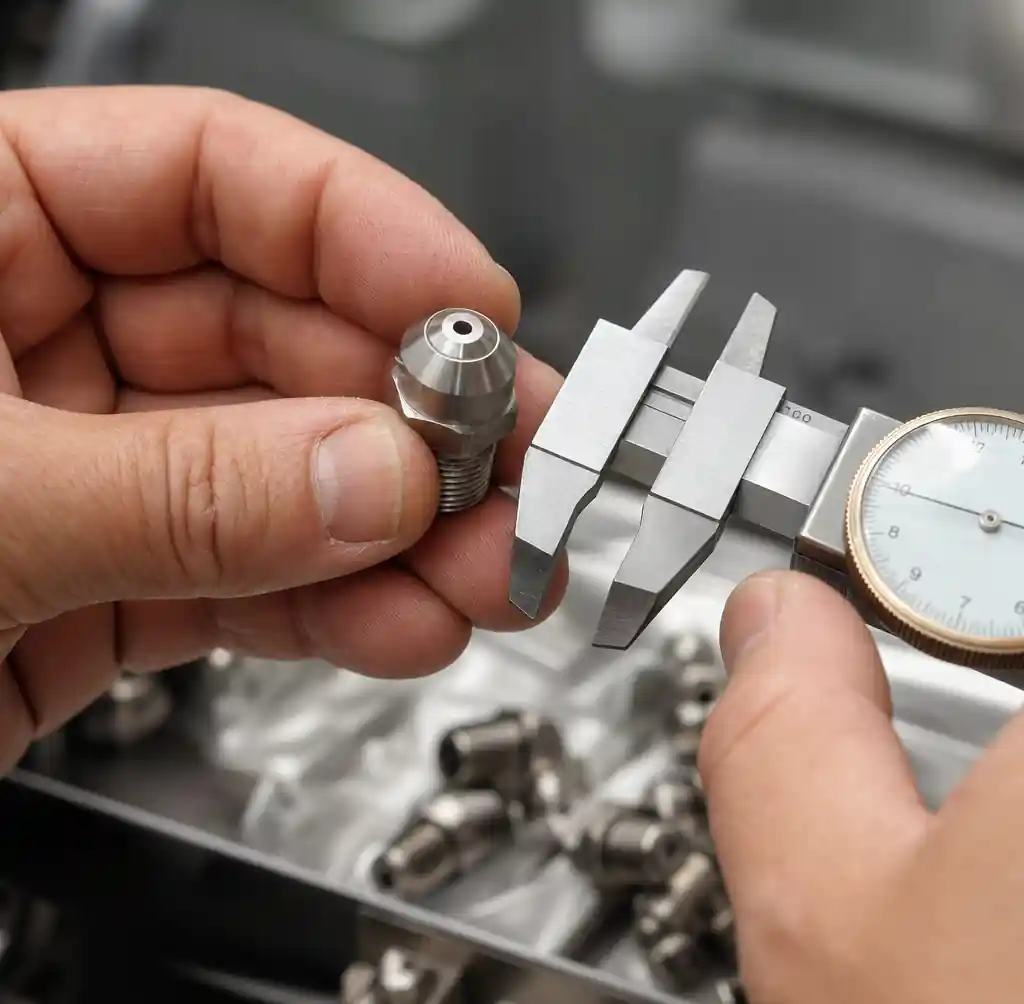
6-water-mist-nozzle-selection-inspection Technician inspecting a water mist nozzle component during system specification

System designers often over-focus on catalog K-factor values while under-examining the interdependencies that determine actual performance.

K-factor: Q = K√P. This governs flow at operating pressure. Suppression-grade nozzles typically range from K = 0.25 to 2.0. Always confirm the K-factor against the system's hydraulic design pressure—not nameplate pressure.

Orifice diameter and spray angle: Smaller orifices at a given pressure produce finer droplets but reduce total flow. Spray angle sets coverage zone and nozzle spacing. These are designed together, not independently.

Operating pressure band: Nozzles are listed for a specific range. Operating below minimum activation pressure produces coarser droplets and insufficient flow. Operating above maximum rated pressure risks accelerated orifice wear.

Material and corrosion resistance: For marine, chemical process, or permanently humid installations, SS316L stainless steel is the minimum specification. Brass nozzles are appropriate for dry, clean-water environments.

Third-party listing: Only nozzles listed under NFPA 750, FM, UL, or an equivalent national authority should be used in suppression systems. Uncertified substitutions void system approval regardless of published flow characteristics.

FAQ

What droplet size qualifies a system as water mist?

NFPA 750 classifies water mist by Dv99 below 1,000 µm. High-pressure systems routinely achieve Dv50 values of 30–100 µm. Smaller median droplets mean greater surface area per liter of water—and faster heat extraction from the fire.

Can water mist suppress Class B flammable liquid fires?

Yes, under specifically designed and listed systems. High-pressure water mist can extinguish Class B fires by cooling fuel surfaces below flash point and displacing oxygen. NFPA 750 requires Class B-specific listed combinations—general-purpose nozzles are not sufficient.

Does water mist damage electronic equipment?

Significantly less than conventional sprinklers. Low discharge volume and fine droplet size reduce hardware exposure substantially. Systems for electrical environments incorporate discharge-shutdown sequencing and listed nozzle selections.

How often do water mist nozzles require maintenance?

Annual visual inspection is standard. Full flow testing is required every five years per NFPA 750. Sub-millimeter orifices are susceptible to mineral scale—treated, filtered water per design specification is essential for maintaining rated performance.

Is water mist approved for marine use?

Yes. IMO MSC/Circ.1533 and the FSS Code govern type-approval requirements. Marine-grade nozzles must pass IMO fire testing and be installed as part of a fully listed system configuration to retain approval status.

Conclusion

Water mist fire suppression is not a newer version of the sprinkler—it is a fundamentally different engineering approach, built on droplet physics rather than water volume.

The nozzle is where that physics is realized. Orifice geometry, pressure class, spray pattern, and material specification determine whether a system suppresses fire in seconds or falls short under a growing event. Choosing a nozzle without verifying pressure-class listing, K-factor match, and third-party approval creates a compliance gap that only shows under real conditions.

Research from early 2026 continues to refine models for droplet penetration into shielded fires, and combined systems pairing water mist with low-GWP clean agents are expanding in high-value asset environments.

Start from the hazard classification and work backward to the nozzle. The physics will tell you what you need.