
How to Master Greenhouse Misting for Seedlings: Dry Mist, VPD, and Clog-Free Nozzles

May 26, 2026
瀏覽次數: 38

If you are a commercial greenhouse grower or an advanced hydroponic hobbyist, you already know the heartbreak of losing an entire tray of delicate seedlings to Botrytis (gray mold) or damping-off. You spend thousands dialing in your lighting and nutrients, only to have your misting system betray you. Nozzles drip, large water droplets physically crush fragile stems, and hard water clogs your system right when your plants need humidity the most.

The secret to a perfect seedling environment isn't just "more water"—it is precise moisture control. In this comprehensive guide, we will break down the exact science of greenhouse misting. You will learn how to manipulate Vapor Pressure Deficit (VPD), choose the right droplet size (microns), completely eliminate nozzle dripping, and finally solve the hard water clogging nightmare that plagues so many growers.

Commercial greenhouse seedling propagation with ultra-fine dry misting system in operation

Table of Contents

1. Understanding Greenhouse Misting for Seedlings: The Basics

For commercial agriculture, the seedling and propagation phase is the most critical bottleneck in your production cycle. Cuttings and newly germinated seeds lack a developed root system. Because they cannot pull up water from the soil efficiently, they rely entirely on their leaves to absorb moisture and survive.

If the air in your greenhouse is too dry, the seedlings will transpire (sweat) moisture faster than they can replace it, leading to fatal wilting. If the air is too wet, or if liquid water sits on the leaves, you create a breeding ground for fungal pathogens like Botrytis cinerea and Pythium.

This is where standard irrigation fails and high-pressure misting becomes essential. A properly engineered misting system does not "water" the plants; it conditions the air. By injecting microscopic water droplets into the environment, you can lower the ambient temperature and raise the humidity simultaneously, creating a microclimate that allows delicate plants to focus their energy on rapid root development rather than survival.

However, the margin for error is razor-thin. Using the wrong nozzles, running improper pressure, or ignoring water filtration will actively destroy your crop. To achieve high survival rates and maximize your ROI, you must transition from traditional sprinkling to precision atmospheric control.

2. Core Concepts Simplified: VPD, Microns, and "Dry Mist"

To make intelligent purchasing decisions for your greenhouse infrastructure, you must understand the physics of water and air. Let's strip away the complex engineering jargon and look at the three core metrics that dictate plant health.

Vapor Pressure Deficit (VPD): The "Drying Power" of the Air

VPD is a measure of how much moisture the air can still hold at a given temperature before it reaches saturation (100% humidity).

  • High VPD: The air is very dry and thirsty. It will forcefully suck water out of your seedlings' leaves.
  • Low VPD: The air is nearly saturated. It pulls very little water from the plants.

For seedlings and unrooted cuttings, you want a low VPD (typically between 0.4 to 0.8 kPa). Because they have no roots, you must minimize the "drying power" of the air so they don't dehydrate. Fine misting is the most efficient way to lower VPD instantly.

Microns: The Anatomy of a Water Droplet

A micron (micrometer) is one-thousandth of a millimeter. To put this in perspective, a human hair is about 70 to 100 microns thick. When it comes to greenhouse nozzles, size is everything.

  • Raindrops: 1,000+ microns.
  • Standard Sprinklers: 300 - 500 microns.
  • Low-Pressure Misters: 50 - 100 microns (Will eventually fall and wet surfaces).
  • High-Pressure Fog/Mist: 5 - 15 microns.

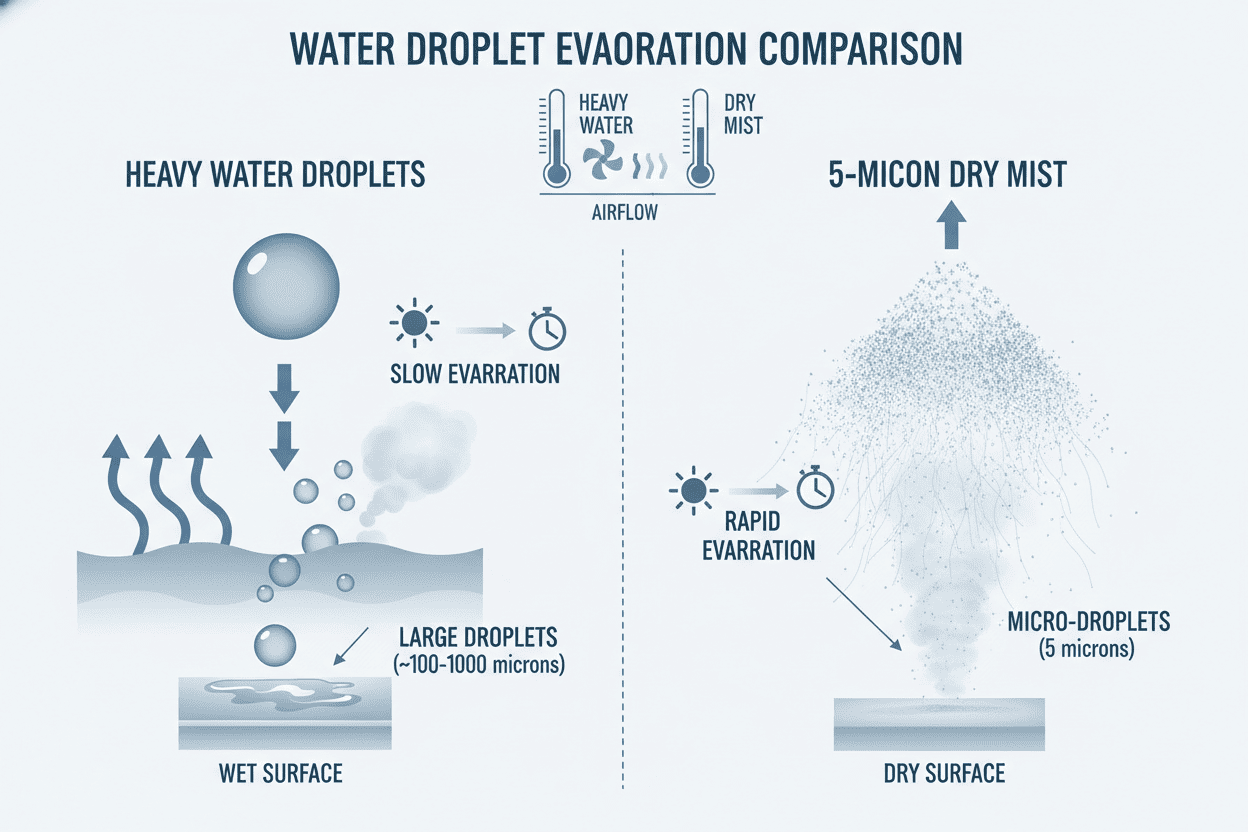
For fragile seedlings, 5 to 15 microns is the absolute sweet spot. Droplets this small lack the mass to fall quickly. Instead, they remain suspended in the air currents and undergo "flash evaporation."

The Magic of "Dry Mist"

This flash evaporation leads us to the most crucial concept in modern propagation: dry mist technology. Dry mist refers to an atomization process where droplets are so microscopic that they evaporate completely into the air before they ever touch a surface or a plant leaf.

Why is this a game-changer? Because it allows you to cool the greenhouse and push humidity to 90%+ without ever leaving standing water on the foliage. Dry leaves mean fungal spores cannot germinate. You get all the benefits of high humidity with zero risk of mold.

Comparison Table: Traditional Sprinklers vs. Dry Mist Nozzles

Feature Traditional Sprinklers / Low-Pressure Misters High-Pressure "Dry Mist" Nozzles Impact on Seedlings
Droplet Size 100 - 500 microns 5 - 15 microns Dry mist floats; standard mist crushes small plants.
Leaf Wetness High (Leaves become soaked) Zero to Minimal (Evaporates in air) Dry mist prevents Botrytis and damping-off.
Cooling Efficiency Poor (Water pools on the ground) Excellent (Flash evaporation absorbs heat) Dry mist reduces heat stress without drowning soil.
Operating Pressure 30 - 60 PSI (2 - 4 Bar) 800 - 1000+ PSI (55 - 70 Bar) High pressure is required to shatter water into fog.
Energy Usage Low Moderate (Requires high-pressure pump) Higher upfront cost, but massive ROI in crop survival.

Diagram illustrating the difference between heavy water droplets and 5-micron dry mist evaporating

3. Step-by-Step Guide: Selecting and Maintaining Your Misting System

Upgrading your greenhouse to a precision misting system requires careful planning. A common mistake growers make is buying cheap nozzles on Amazon, hooking them up to a standard garden hose, and wondering why their greenhouse turns into a swamp. Here is the pragmatic, step-by-step approach to doing it right.

3.1 Sizing the Right Nozzle (Specs & Data)

Not all nozzles are created equal. The orifice (the tiny hole the water shoots through) determines the droplet size, but only if you supply the correct water pressure. To achieve true dry mist, you need a high-pressure pump (usually 800 to 1000 PSI) paired with the correct nozzle orifice size.

Specification & Data Table: Choosing Your Nozzle Orifice

Nozzle Orifice Size (mm) Nozzle Orifice Size (inch) Avg. Droplet Size at 1000 PSI Flow Rate (Liters/Min) Best Application in Agriculture
0.10 mm 0.004" 5 - 10 Microns 0.02 - 0.03 L/min Ideal for Seedlings/Propagation. Maximum flash evaporation. Lowest wetting risk.
0.15 mm 0.006" 10 - 15 Microns 0.04 - 0.05 L/min Excellent for general greenhouse humidity control and cooling.
0.20 mm 0.008" 15 - 20 Microns 0.06 - 0.08 L/min Good for mature plants, tropicals, or outdoor patio cooling.
0.30 mm+ 0.012"+ 25+ Microns 0.10+ L/min Avoid for indoor greenhouses. Will cause heavy wetting and pooling.

Actionable Advice: For propagation benches, always default to 0.10mm or 0.15mm orifices. They require stricter filtration, but the biological safety they provide for your seedlings is unmatched.

3.2 The Non-Negotiable: Anti-Drip Features

If you browse Reddit forums like r/Greenhouses or r/macrogrowery, you will see one complaint repeated constantly: "My misting system turns off, but the nozzles keep dripping water for 5 minutes."

This is called after-drip, and it is a silent killer. When the high-pressure pump shuts down, the water remaining in the overhead lines loses pressure. Instead of atomizing into a fine fog, this residual water gathers into massive, heavy drops. When a 2,000-micron drop falls from 6 feet in the air onto a 3-day-old seedling, it is like a bowling ball hitting a human. It can snap the stem, wash away the growing media, or leave a localized puddle that rots the root zone.

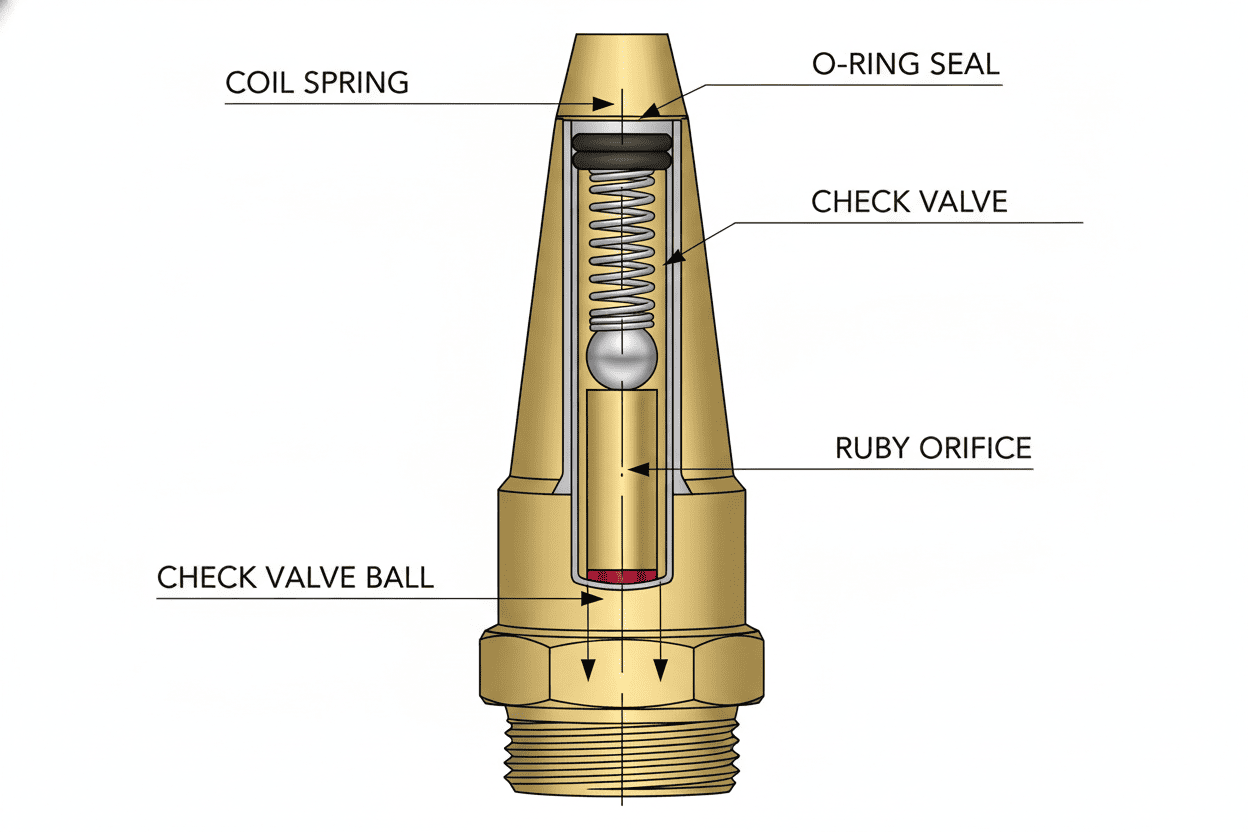
The Solution: Anti-Drip Check Valves When purchasing nozzles, you must ensure they contain an internal anti-drip check valve.

How it works: Inside the nozzle body sits a tiny, spring-loaded plunger (often made of stainless steel or Viton rubber). When the pump is running at 1000 PSI, the water pressure forces the spring open. The exact second the pump turns off and pressure drops below a certain threshold (usually around 150-300 PSI), the spring violently snaps shut. This instantly seals the orifice from the inside, trapping the water in the line and preventing even a single drop from falling onto your crop.

Cross-section of an anti-drip misting nozzle showing the internal spring and check valve mechanism

3.3 Solving the Hard Water Clogging Nightmare

The second most common point of failure is clogging. A 0.10mm orifice is incredibly tiny—far smaller than a grain of sand. If your water source has high mineral content (calcium and magnesium, common in well water) or suspended particulates, your nozzles will clog within days.

A clogged nozzle means uneven humidity distribution. Some trays will dry out and die, while others get overwatered. Here is how to bulletproof your system against clogs:

1. Multi-Stage Filtration (The First Line of Defense) Never run raw tap or well water directly into a high-pressure mist pump. You need a stepped filtration system:

  • Stage 1: A 50-micron pleated filter to catch large sediment, sand, and rust.
  • Stage 2: A 5-micron spun polypropylene filter to catch fine silt.
  • Stage 3 (Optional but Recommended): A 1-micron filter immediately before the pump intake to protect the ceramic plungers of the pump and the ultra-fine nozzles.

2. Water Treatment (Reverse Osmosis) If your water hardness is above 100 ppm (parts per million), standard filters will not stop calcium scale from building up on the tip of the nozzle as the water evaporates. For commercial setups, running your misting system on a Reverse Osmosis (RO) water system is highly recommended. RO strips the water of all minerals, ensuring your nozzles can run for years without calcification.

3. Material Selection: Stainless Steel and Ceramic Avoid cheap plastic or low-grade brass nozzles with plastic inserts. They degrade quickly under high pressure and are impossible to clean. Invest in nozzles with stainless steel bodies and ceramic orifice inserts. Ceramic is incredibly hard, resists mineral buildup better than metal, and maintains a perfect spray pattern over time.

4. Expert Tips & Common Pitfalls to Avoid

Even with the best hardware, operational errors can ruin your efficiency. Drawing from the collective experience of agricultural engineers and commercial growers, here are the pitfalls you must avoid.

Pitfall 1: Placing Nozzles Too Close to the Canopy

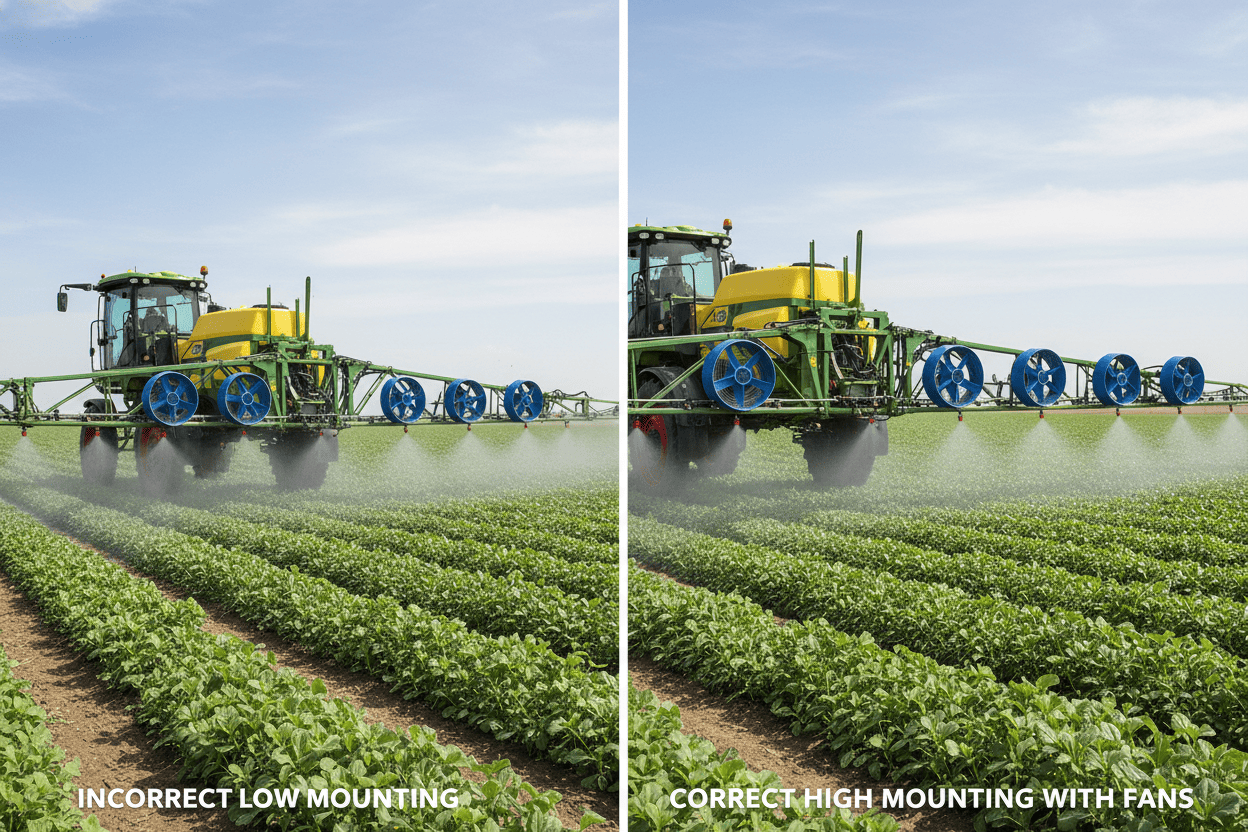
Because high-pressure mist exits the nozzle at extreme velocities, it needs vertical distance to slow down, expand, and evaporate. If you mount nozzles 2 feet above your seedling trays, the mist will hit the plants before it has time to flash evaporate, completely defeating the purpose of a dry mist system.

  • Expert Tip: Mount misting lines at least 6 to 8 feet (1.8 to 2.4 meters) above the plant canopy. If your greenhouse ceiling is low, angle the nozzles upward at a 45-degree angle or direct them into the airflow of circulation fans to maximize "hang time" in the air.

Pitfall 2: Relying solely on Timers instead of Sensors

Running a misting system on a dumb timer (e.g., 10 seconds on, 5 minutes off) is dangerous. Weather changes rapidly. A timer setting that works perfectly at noon will flood your greenhouse at 6 PM when the sun goes down and ambient humidity naturally rises.

  • Expert Tip: Integrate your misting system with a centralized climate controller that measures VPD or relative humidity (RH). The system should only pulse on when the VPD rises above your set point, ensuring you never over-saturate the environment.

Comparison showing incorrect low mounting of nozzles vs correct high mounting with fans

Upgrading to Industrial-Grade Solutions

If you are currently struggling with a pieced-together DIY system that constantly breaks down, drips, or clogs, it is likely costing you more in lost crop yield and labor than the price of a proper system. For commercial facilities looking to eliminate these variables, transitioning to high-precision mist cooling solutions is the most logical step. Industrial-grade systems offer precise micron control, heavy-duty anti-drip valves, and integrated filtration that completely automates your VPD management, allowing you to focus on growing rather than plumbing.

5. Conclusion & Final Thoughts

Successfully propagating seedlings requires a delicate balance of temperature and humidity. By moving away from traditional watering methods and embracing high-pressure, ultra-fine misting technology, you can drastically reduce plant stress, eliminate the risk of fungal diseases, and accelerate root growth.

Remember, the goal is to condition the air, not wet the plant. Prioritize droplet size (5-15 microns), insist on anti-drip check valves to protect your crop from physical damage, and implement strict water filtration to keep your system running clog-free.

6. Frequently Asked Questions

Q1: What is the ideal droplet size for greenhouse seedling propagation? A: 5 to 15 microns. This creates "dry mist" that flash evaporates before touching leaves, preventing fungal diseases.

Q2: Why do my misting nozzles keep dripping after shutoff? A: You need anti-drip check valves. These spring-loaded valves seal the orifice instantly when pressure drops, preventing destructive after-drip.

Q3: How do I prevent hard water from clogging my nozzles? A: Use multi-stage filtration (down to 1-5 microns) and consider Reverse Osmosis water. Choose stainless steel nozzles with ceramic orifices.

Q4: What is VPD and why does it matter for seedlings? A: Vapor Pressure Deficit measures air's drying power. Keep it between 0.4-0.8 kPa for seedlings to prevent dehydration without causing mold.

Q5: How high should I mount misting nozzles above seedlings? A: Mount at least 6-8 feet above the canopy. Lower mounting causes wetting before evaporation; higher mounting allows proper flash evaporation.

Quick Summary: Greenhouse Misting Best Practices

Component / Metric The "Wrong" Way The "Right" Way (Commercial Standard)
Droplet Size > 50 microns (Wets leaves, causes mold) 5 - 15 microns (Dry mist, flash evaporates)
Nozzle Valve Open orifice (Drips when turned off) Anti-Drip Check Valve (Instant shut-off)
Water Quality Unfiltered tap/well water (Clogs instantly) 5-micron filtration + RO water (Zero clogs)
Control System Basic interval timers (Ignores weather) VPD / Humidity sensor-driven controllers
Mounting Height Low, pointing directly at plants High (6-8ft+), utilizing circulation fans

If you are expanding your agricultural or industrial operations, the principles of high-pressure atomization extend far beyond just greenhouse humidity. The exact same fluid dynamics and nozzle engineering are utilized in other critical facility management areas. For instance, if you manage large-scale agricultural waste, composting facilities, or processing plants, you can explore how this technology is adapted for atomized deodorizing systems to neutralize airborne odors efficiently.

Ready to upgrade your propagation environment? Stop losing seedlings to poor climate control. Evaluate your current water pressure, check your filtration, and make the switch to precision anti-drip nozzles today.